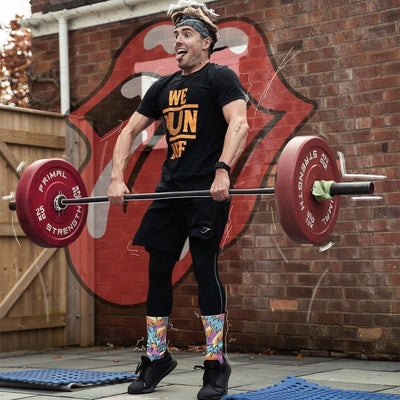
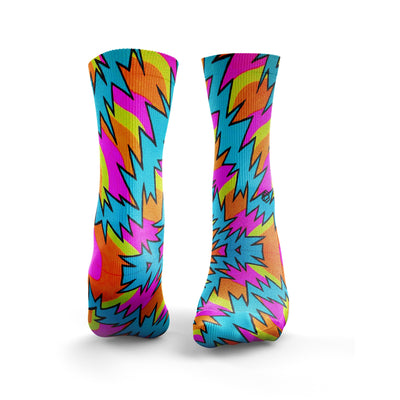
If you've signed up for your first race (or you're thinking about it), the HYROX stations are probably the part keeping you up at night. The running is simple enough to picture: eight lots of 1 km. It's the eight workouts in between that make HYROX what it is. This guide walks through the HYROX stations in race order, explains what each one asks of you, and gives you practical ways to train for them, plus a quick word on the kit that helps, including the right HYROX socks.
How a HYROX race works
Every HYROX race follows the same format: you run 1 km, then complete one workout station, and repeat that eight times. That adds up to 8 km of running and eight stations, always in the same order. According to the official HYROX rulebook, the running distance is the same for every division; what changes between divisions is the weight you carry, push, pull and throw.
The 8 HYROX stations, in order
Here's the full line-up. Distances and reps are taken from the official HYROX Season 26/27 singles rulebook. Weights depend on your division, so always check the current rulebook for your race before you start training.
1. SkiErg – 1,000 m
The opening station is 1,000 m on the SkiErg. It looks like an arm exercise, but the power comes from hinging at the hips and driving down with your whole body.
How to train it: practise long, steady pieces on the SkiErg at the pace you'd race, and work on a strong hip hinge rather than just pulling with your arms.
2. Sled push – 50 m
Next up is the sled push: 50 m, split into four lengths of 12.5 m. For many people this is the station that hurts the legs most. Body position is everything: arms extended or bent against the poles, a forward lean, and short, powerful steps driving through the balls of your feet.
How to train it: if your gym has a sled, practise pushes at or near race weight. If not, heavy prowler work, wall-sit holds and leg strength sessions with plenty of squats and lunges will all help.
3. Sled pull – 50 m
The sled pull is also 50 m in four 12.5 m lengths, but this time you pull the sled towards you with a rope, hand over hand, while staying in a marked area. Sit back into your legs and use your bodyweight; arms alone will fade fast.
How to train it: rope pulls, rows and grip work. Practise sitting low and walking backwards to reset your position quickly between pulls.
4. Burpee broad jumps – 80 m
Station four covers 80 m of burpee broad jumps. You drop your chest to the floor, stand up and jump forward with both feet, again and again.
How to train it: practise burpee broad jumps at a sustainable pace, focusing on efficient step-up or jump-up technique and controlled landings.
5. Rowing – 1,000 m
The second ergometer is 1,000 m on the rower, and it marks the start of the second half of the race. Focus on long, strong strokes driven by the legs rather than a high, choppy stroke rate.
How to train it: steady rowing intervals at race pace, plus technique work on the leg drive, body swing and arm pull order.
6. Farmers carry – 200 m
Station six is a 200 m farmers carry with a kettlebell in each hand. Depending on the venue, that may mean more than one lap, so check the athlete map. Stand tall, brace your core, keep your shoulders back and take quick, short steps. Your grip will be the first thing to complain.
How to train it: loaded carries with kettlebells or dumbbells, dead hangs and other grip work. Practise carrying over longer distances than you think you need.
7. Sandbag lunges – 100 m
Then come 100 m of walking lunges with a sandbag on your shoulders. The rulebook requires your trailing knee to clearly touch the ground on every lunge, alternating legs, and you finish each rep standing tall.
How to train it: walking lunges with a sandbag or weight, split squats and step-ups. Include some lunges straight after running to get used to that heavy-leg feeling.
8. Wall balls – 100 reps
The final station is 100 wall balls: squat with a medicine ball and throw it up to hit a target, then catch it and go straight into the next rep. The 100th rep finishes your race. Break the set up into manageable chunks early, rather than going until failure and then needing long rests.
How to train it: wall ball sets in your conditioning sessions, practised when you're already tired. Work on catching the ball into a squat so each rep flows into the next.
HYROX weights by division
Here are the station weights from the official HYROX Season 26/27 singles rulebook. Rules can change between seasons, so double-check the current version for your event.
- Women Open: sled push 102 kg incl. sled, sled pull 78 kg incl. sled, farmers carry 2 x 16 kg, sandbag lunges 10 kg, wall balls 4 kg.
- Men Open and Women Pro: sled push 152 kg incl. sled, sled pull 103 kg incl. sled, farmers carry 2 x 24 kg, sandbag lunges 20 kg, wall balls 6 kg.
- Men Pro: sled push 202 kg incl. sled, sled pull 153 kg incl. sled, farmers carry 2 x 32 kg, sandbag lunges 30 kg, wall balls 9 kg.
Racing with a mate? The stations are the same, but you share the work. Our guide to HYROX Doubles explains how to race and train as a pair.
How to train for the HYROX stations
You don't need a full HYROX setup to get race-ready. A few simple principles go a long way:
- Train the runs and the stations together. The hardest part of HYROX is doing the workouts on tired legs. Add short runs before and after station work so you practise that transition.
- Get strong in your legs and grip. Sled push, sled pull, farmers carry, lunges and wall balls all lean heavily on your legs and grip. Regular strength work makes every one of them feel more manageable.
- Learn pacing. Most people's biggest mistake is going too hard early. Practise a pace you can repeat across all eight runs and stations.
If you're unsure where to start, speak to a coach at your gym.
What to wear on your feet for the HYROX stations
With 8 km of running and lots of pushing, pulling, lunging and squatting, your feet take a lot over the course of a race. Shoes get most of the attention, but socks matter too. Blisters halfway through the farmers carry are nobody's idea of fun. For more on that, read our guide on how to stop blisters in CrossFit and HYROX.
Here are a few pairs from our range that suit a HYROX race:
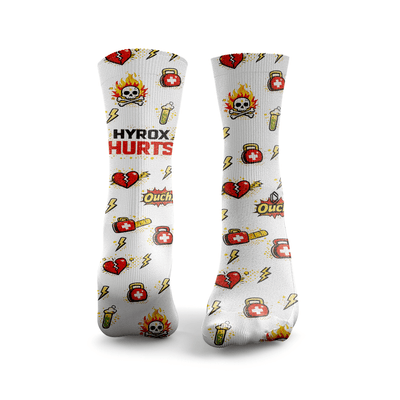
Hyrox Hurts
The name says it all. As the product page puts it: "HYROX hurts. Your socks shouldn’t." Hyrox Hurts are crew socks with "built-in arch support with plush cloud-like cushioning at the ankle and forefoot to help absorb impact", and they're "Made with anti-abrasion fibres deep within the sock."
Multicolour Wall Ball Warrior 2Stripe
Made for station eight. The Wall Ball Warrior 2Stripe socks are "Built for the grinders who thrive in the pain cave." They feature "Enhanced airflow across the top of the foot" and "a snug, secure fit designed specifically to help 'hug' your foot."
Send It Pro Performance
If you like the feeling of your foot locked into your shoe for sled pushes and quick changes of direction, try our grip socks. Send It Pro Performance socks "feature a fully covered sole with a honeycomb grip design", with "Increased stability of a 'grounded' foot." To be clear, the grip works between your foot and your shoe, not on the floor. You can find more styles in our grip socks collection.
Quadzilla
For the sandbag lunges (and every leg day in between), there's Quadzilla: "King of leg day." Like our other crew socks, they're designed with "four-yarn terry loops to create a supremely soft and supportive athletic sock."
Want more options? Browse our full range of HYROX socks, or see our round-up of the best socks for HYROX. Plenty of our CrossFit socks work brilliantly on race day too.
One tip: never race in brand-new socks or shoes. Wear your race-day pair for a few training sessions first, ideally including a run and some lunges, so you know they feel right.
HYROX stations FAQ
How many stations are there in HYROX?
There are eight HYROX stations: SkiErg, sled push, sled pull, burpee broad jumps, rowing, farmers carry, sandbag lunges and wall balls. Each one comes after a 1 km run.
What order are the HYROX stations in?
The order is always the same: 1. SkiErg, 2. sled push, 3. sled pull, 4. burpee broad jumps, 5. rowing, 6. farmers carry, 7. sandbag lunges, 8. wall balls.
Which HYROX station is the hardest?
It depends on the athlete. Many people find the sled push and sandbag lunges the toughest on the legs, while others dread the burpee broad jumps or the final wall balls. Train your weakest station the most.
Can I train for HYROX without a sled or SkiErg?
Yes. Leg strength work, heavy carries, rowing and running will cover a lot of the demands. Try to get some practice on the real equipment before race day so you know how it feels.
What socks should I wear for HYROX?
Choose socks you've already trained in, with a snug fit and cushioning that suits running and the stations. Browse our HYROX socks to find your race-day pair.
Eight runs, eight stations, one finish line. Learn the stations, train them on tired legs, and turn up in kit you trust. See you at the wall balls.